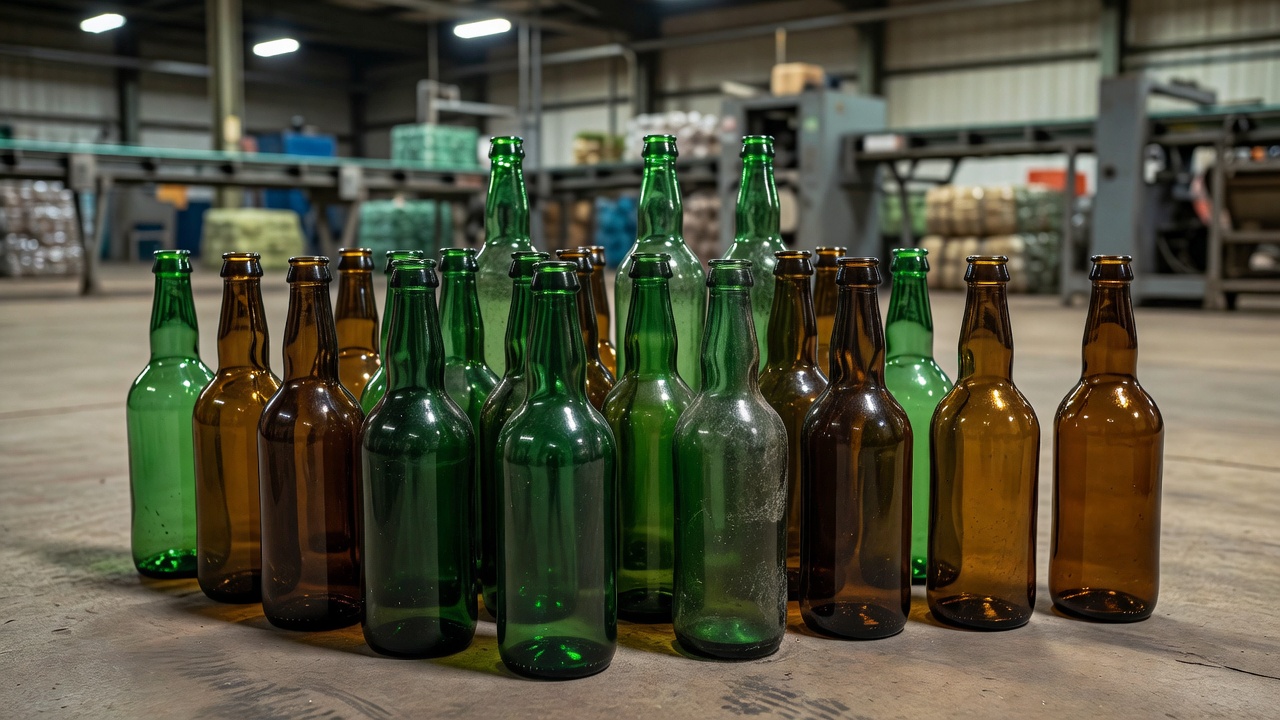
Meet cullet, the recovered input
Cullet is broken glass prepared for use as a manufacturing input. In container production, suitable cullet can substitute for part of the batch of raw materials used to make new glass. It can also reduce the energy required by the melting process. The practical outcome depends on the furnace, glass composition, available cullet and the quality specifications of the finished product.
Not all cullet has the same history. Manufacturing rejects may be returned internally to a glass process, while recovered bottles and jars arrive through collection systems. When evaluating a recycled-content statement, ask which inputs count under the producer’s chosen definition. Routine internal process returns should not automatically be treated as equivalent to recovered post-consumer glass in a consumer-facing claim.
Composition matters more than appearance
Many bottles and jars are made from soda-lime glass. Heat-resistant cookware can use different compositions, and drinking glasses, mirrors, lamps and window products can introduce other complications. Ceramics and stones are particularly unwelcome contaminants in container-glass streams because they do not behave like compatible container glass during processing. A small-looking wrong item can create a real manufacturing problem.
This is why “glass recycling” rarely means that every transparent or brittle object belongs in the same bin. The Glass Packaging Institute and FEVE, the European Container Glass Federation, provide context for container-glass systems. Their industry information helps explain the process, but local collection instructions remain the practical authority for deciding which household items are accepted.
Colour can change the next destination
Colour sorting can support the production of glass with specific colour requirements. Clear glass production generally needs tighter control of coloured contamination than some darker container applications. Collection arrangements therefore vary: one area may separate colours at a bottle bank, while another uses mixed collection followed by sorting. Follow the system available to you rather than assuming that another region’s instructions apply.
Recovered glass can also enter products such as insulation, aggregates or decorative surfaces. These are different pathways from bottle-to-bottle recycling and may have different quality requirements and future recovery options. A claim about “diverting glass from landfill” does not, by itself, establish that the resulting product has a functioning repeated recycling loop.
Judge the finished product on its own terms
A recycled-glass vase needs stability and an appropriate finish. A drinking vessel needs suitability for its intended food-contact use. A tile needs relevant installation and performance information. Recycled origin does not establish any of those properties automatically. Bubbles, colour variations and a handmade appearance can be aesthetic features, but they are not reliable evidence of a recycled percentage.
Be especially careful with heat. Do not assume that a heavy tumbler can hold boiling water or that a reused jar is safe in an oven. Thermal-shock resistance depends on composition, treatment, design and condition. Follow the manufacturer’s instructions, and stop using items with damage that makes their intended use unsafe. Environmental enthusiasm should not substitute for ordinary product safety.
Compare reuse and remelting carefully
A refillable bottle can avoid repeated production of new containers when it operates within a suitable collection and washing system. But the comparison depends on return rates, transport distances, bottle weight, cleaning and the number of actual reuse cycles. A bottle marketed as reusable does not achieve repeated use simply by existing. The system and the user’s behaviour have to deliver those trips.
For household storage, keeping a suitable jar in service can be a simple way to extend its life. That does not make every informal reuse appropriate: lids, seals and the intended contents matter. Home food preservation requires tested methods and suitable equipment. This guide does not establish that a previously used container is safe for canning or another specialised application.
Look for a bounded content claim
Ask whether a percentage applies to the glass body, the whole product or a production average. A recycled-glass bottle may include a cap, sleeve and label with separate material histories. Avoid treating a glass-content claim as an all-components claim. If the manufacturer gives only a range, ask why it varies and whether that range relates to the item you are buying.
Life-cycle comparisons also need a clear basis. Glass is relatively heavy, so transport can matter, but weight alone does not settle the comparison with another material. Breakage, reuse, food protection and recovery routes also influence the service provided. A useful comparison examines equivalent functions under stated assumptions rather than declaring one material universally superior.
Finish with the local instructions
Recycle Now, operated by WRAP, and the United States Environmental Protection Agency offer starting points for understanding recycling, but neither can replace every local collector’s rules. Check whether your service accepts bottles and jars, how it treats lids and whether it requires colour separation. Do not put drinking glasses or heat-resistant cookware into container collection unless your service explicitly accepts them.
Keep usable items in circulation where there is a genuine need. Handle broken glass according to local safety guidance rather than placing loose shards into an unsuitable collection stream. The most credible material story is not the one that promises an effortless loop. It is the one that names the specific glass, the useful purpose and the available next destination.