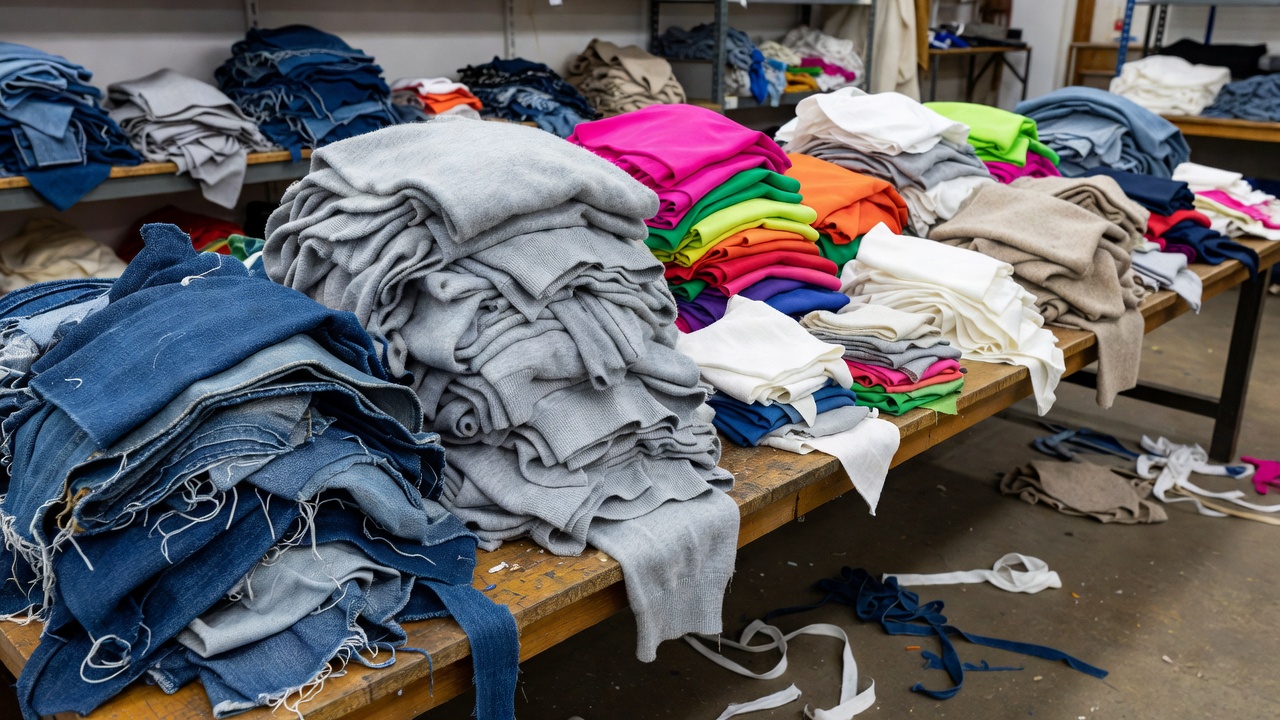
Distinguish reuse from fibre recovery
A second-hand coat, a tote sewn from an old curtain and a shirt made with recycled cotton represent different interventions. The coat remains a finished garment. The curtain keeps much of its existing fabric structure. Recycled cotton usually involves recovering fibres from a previous material and manufacturing a new textile. These distinctions explain which processing stages are avoided and which still need to happen.
The input can be relatively uniform cutting-room waste or a much more varied collection of used clothing. Buttons, zips, prints, coatings and unknown blends can complicate processing. A supplier who identifies its feedstock gives you a better starting point than one who relies on a vague “rescued fabric” description. Neither pre-consumer nor post-consumer origin is, on its own, a full environmental comparison.
Follow what happens to fibre quality
Mechanical recycling opens and tears textiles back into fibres. For cotton, this can shorten the recovered fibres, affecting the strength and consistency of new yarn. Manufacturers may blend them with longer virgin fibres or use them in products with different performance needs. The important question is whether the resulting cloth will survive its intended use, not whether blending sounds less pure.
Recycled wool has a long industrial history, including in Prato, Italy. Sorting by colour and fibre type can help determine the next fabric’s properties and processing needs. But historical expertise is not evidence for every modern product claim. Ask how much recycled wool is present, what other fibres are included and whether the fabric is suitable for its stated care routine.
Polyester introduces a different pathway. Recycled polyester may originate in PET bottles rather than discarded clothing. That can be a legitimate recycled input, but it should not be described as textile-to-textile recycling unless textiles actually supplied the feedstock. Chemical or dissolution-based textile processes also differ in the blends they can accept and the outputs they produce. Avoid treating emerging processes as universally available collection systems.
Use certification within its limits
Textile Exchange’s Recycled Claim Standard and Global Recycled Standard are useful references for recycled inputs and chain-of-custody requirements. Their scopes are not identical: the Global Recycled Standard includes additional processing requirements. Neither should be reduced to a generic green badge. Check the applicable standard, the certified organisation and documentation relating to the product and transaction where available.
A scope certificate can establish that an organisation is certified for specified activities; it does not by itself prove that every product it sells carries the claimed content. Similarly, OEKO-TEX STANDARD 100 addresses testing for harmful substances within its scope, not the percentage of recycled fibre. Different labels can answer different questions. Read the accompanying claim rather than assuming one certificate resolves all environmental and safety concerns.
Inspect the useful life you are buying
For towels, consider absorbency, edge stitching and washing requirements. For upholstery, look for appropriate abrasion performance and removable covers. For clothing, inspect seam allowances, fasteners and areas likely to rub or stretch. A product that is comfortable and easy to maintain is more likely to remain in use. A recycled-content percentage cannot compensate for a garment that fails its everyday task.
Blended fibres may improve performance while making later separation more difficult. Elastane can provide needed stretch, yet complicate some recovery routes. Waterproof coatings and bonded layers present further trade-offs. This is not a reason to reject every mixed textile. It is a reason to choose functional complexity deliberately and ask whether repair or component replacement is possible.
Care is part of the biography
Follow the care label, wash when needed and avoid unnecessary heat where the fabric allows it. Repair a loose seam before it becomes a larger tear. Synthetic textiles can release microfibres during use and washing; recycled origin does not remove that issue. No single household accessory guarantees complete prevention, so avoid claims that a washing bag or filter makes shedding disappear entirely.
WRAP’s work on textiles is a useful starting point for understanding the role of product life and circular systems. The European Environment Agency also discusses the wider pressures associated with textile consumption. These perspectives encourage looking beyond a single fibre input to purchase frequency, practical durability and what happens after ownership.
Find a credible next destination
Pass on clean, usable items through a route that actually wants them. Donation is not a guarantee of local reuse, and textile collection is not synonymous with fibre-to-fibre recycling. Ask a collection operator what conditions it accepts, how it sorts materials and whether it publishes destination information. Wet or contaminated textiles can damage other collected items and may be excluded.
When evaluating a new purchase, favour a clear fibre composition, a specific recycled-content statement and a realistic care plan. Then ask the simplest question: will you use this item often enough to justify making it? A well-used, repairable textile can be a more considered choice than an unnecessary replacement carrying a higher recycled percentage.